Intro

Welcome friends - I'm posting published articles and sundry items as time allows. Most subjects pertain to conservation, photo trekking and tourism in borderlands Arizona, USA. More of my articles can be seen on my publisher's website www.TubacVillager.com.

Monday, August 22, 2011

Article: "Vanishing Ranchlands"


(Published June 2008 in Murray Bolesta's "The Borderlands Photographer" in Tubac Villager.)


Preserving open spaces in Arizona’s borderlands doesn’t always require the ultimate conservation measure of setting aside pristine landscapes untouched by development or agriculture.

A scene of wide-open freedom in a pristine valley
on the Arizona-Mexico border.
Ranchlands, whether private or leased from the government, represent an expansive rural heritage of Arizona as significant as the natural heritage of undisturbed desert habitat. Importantly, for you, the borderlands photographer, they also provide great picture-taking opportunity.

Some of the various habitats, or biomes, of the Sonoran Desert and surrounding areas here in southern Arizona have enabled ranching to various degrees of success. From desert grassland to the pine forests, grazing continues.

Photo opportunities abound within both the living and the preserved, or converted, ranchlands in our area. I describe living ranchlands as domains of folks who still lead a classic western life on a range with cattle, horses, and other livestock.

I categorize preserved ranchlands as those tracts which have been set aside from prior ranching use and allowed to revert more or less to their original natural form. These ranchlands have been protected by a wide variety of conservationist interests, from private activists to non-profit foundations and the federal government. Examples locally are Buenos Aires National Wildlife Refuge at Arivaca, the Empire Ranch/Las Cienegas Conservation Area at Sonoita, and the Audubon Society’s Appleton-Whittell Research Ranch at Elgin.
Historic, precious ranch structures add character
to an image of the vanishing ranchlands, here
seen in Muleshoe Ranch in south central Arizona.

What great destinations these places are for the borderlands photographer! You can't beat the wide-angle thrill of an afternoon monsoon storm bursting over the yellow grassland vista.

Constantly, the living ranchlands furnish artful western scenes, from cowboys at the corral to horses galloping to cattle grazing to spinning windmills (one of my favorites). 

Further, both the living and the preserved ranchlands contain structures of character and historic significance, such as adobe barns and mesquite fences, also fertile subjects for the photographer.

Go wide! Often the wide open, sprawling country begs for panoramic photos of grasses bending to the breeze and distant mountain horizons reminiscent of western films likely made there.

Men of the range, Empire Ranch, Sonoita, Arizona.
The borderlands photographer uses a wide-angle lens or instead, stitches two or more digital shots together to seize this widescreen grandeur. He or she remembers that quality landscape shots require a tripod for maximum sharpness.

Early morning or late afternoon is best for capturing these landscapes Also, the lucky photographer shows up when there is some weather happening, when skies are filled with more than the dreaded plain blue sky. Landscape shots beg for skies filled with feature and definition. Often the drama of ranchland skies is the highlight of a borderland image.

At day's end you'll have recorded a very fine part of America's heritage. And finally, when you leave for home, after immersing yourself in big-sky country, don’t forget to close the gates!

Saturday, August 6, 2011

Article: "A Mission to Photograph"


(Published May 2008 in Murray Bolesta's "The Borderlands Photographer" in Tubac Villager.)


Churches are photogenic, especially ones that are heritage subjects. But they don’t have to be ancient or elaborate to be good photo subjects. Denomination aside, in this article I’m using the word “church” in a generic sense and I’m visiting some large and small regional buildings purely as architectural photographic destinations.
The mission at Tumacácori is the supermodel of the
 borderlands region: the camera loves her from any angle.

The serenity, charm and visual splendor of any house of worship, whether it’s a church, synagogue, mosque, or other form of this structure, derives from its inspirational purpose and the attention given to its design and maintenance. These structures either contain works of art, or are themselves works of art.

So, naturally, they make great photo subjects. In the Arizona borderlands, some of the original European colonial religious structures sadly are gone or have been reduced to lumps of clay. Others have been stabilized and protected, and there are a few which are remote and hard to protect, so their access is restricted.

These remnants usually aren’t very good photo subjects anyway, since lumps of adobe or mounds of earth don’t amount to much visual impact. The most notable restorations are at Tumacácori just north of the Mexico border and, near Tucson, at San Xavier.

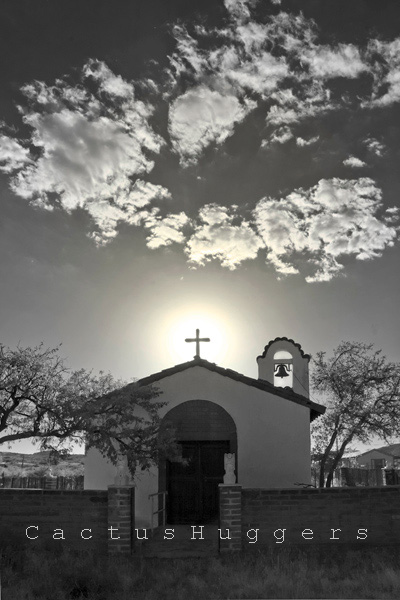
A great little church in a troubled 
place: the border town of Sasabe.
These two structures, Mission San José de Tumacácori, and Mission San Xavier del Bac, are among the most photographed structures in the borderlands region. They’re so popular, in fact, that they amount to a photographic cliché, like Grand Canyon.

But I’ll do it anyway, since they have such significance to you, the borderlands photographer. Briefly, the facts are as follows: I’m not an expert on the Jesuits and Father Kino, so I’ll say little about history; there are at least four different ways to pronounce “San Xavier”, so take your pick; San Xavier is still a fully functioning parish church within the Roman Catholic Diocese of Tucson; Tumacácori is administered by the hardy souls of the National Park Service. 

These structures merit photographers' attention because they’re so striking that it’s hard to take a bad picture of them. Just point and shoot. 

San Xavier may be the greatest gem in Arizona, and Tumacácori is the next best, with its semi-restored frontier splendor and the dramatic backdrop of the nearby Tumacácori mountains and the slightly more distant Santa Rita mountains.

Currently, visitors to San Xavier are a bit disappointed because the west bell tower of their “White Dove of the Desert” is ensconced by scaffolding and sheeting. Visitors want to take a postcard-perfect picture of the structure with a sunset or rainbow background, and they can’t. (Plans are in progress to remove the scaffolding on the west tower, and to begin similar work on the east tower if funding permits.)

But the inventive photographer to San Xavier soon finds more opportunity than just a frontal view of the main structure. For example, inside. This mission is the rustic equivalent of a major European cathedral with artworks throughout the interior. Capturing this detail requires a tripod and the right camera time exposure to compensate for the dim light. Regular flash is inadequate.

Outside the church, the photographer avoids the scaffolding by focusing on other parts of the building and grounds, such as the rear of the complex, the courtyards, mission school, the Mortuary Chapel and, of course, people. The Hispanic and native-Americans residing in the area surrounding the mission who work, worship, or school there can themselves be some of the best photo subjects.

St. Augustine Cathedral in Tucson, Arizona.
Farther south, the folks visiting Tumacácori, on the other hand, are mostly tourists, so the best trick there is to avoid them in your viewfinder completely and wait until they pass!

Truly, just about any angle at Tumacácori can provide great images. Different times of day multiply the opportunities using natural light and the resulting shadows. The smooth curves of the plastered adobe walls on the main structure and out-buildings yield results that make any photographer feel like an expert.

I mustn’t forget some other churches in the area. The large St. Augustine Cathedral in downtown Tucson recently underwent minor improvements. More modest area churches are St. Rita in the Desert in Vail, and structures in the tiny border villages of Sasabe and Lochiel.

While the smaller buildings are less imposing as architecture, the skillful photographer can exploit the charm of their design and milieu, using creative camera angles to prove these churches are as photogenic as any others in the borderlands region.

Tuesday, August 2, 2011

Roads Caller


Opinion: Conflicted About Nature?

Re: NY Times article "As We Seek Nature, We Wall It Out"
 
 
We're not conflicted at all about wild nature. The preponderance of human activity screams the conclusion that we "like" nature and feel sorry for it, but we won't let it get in the way of human "expansion." Thus, its inexorable decline and destruction.
 
Tamed and cultivated nature is another matter.